Science

The science behind the measurements

Useful mobility data starts with understanding what a measurement can tell you.

We compare smartphone measurements with reference methods and study how they work in defined collection settings.
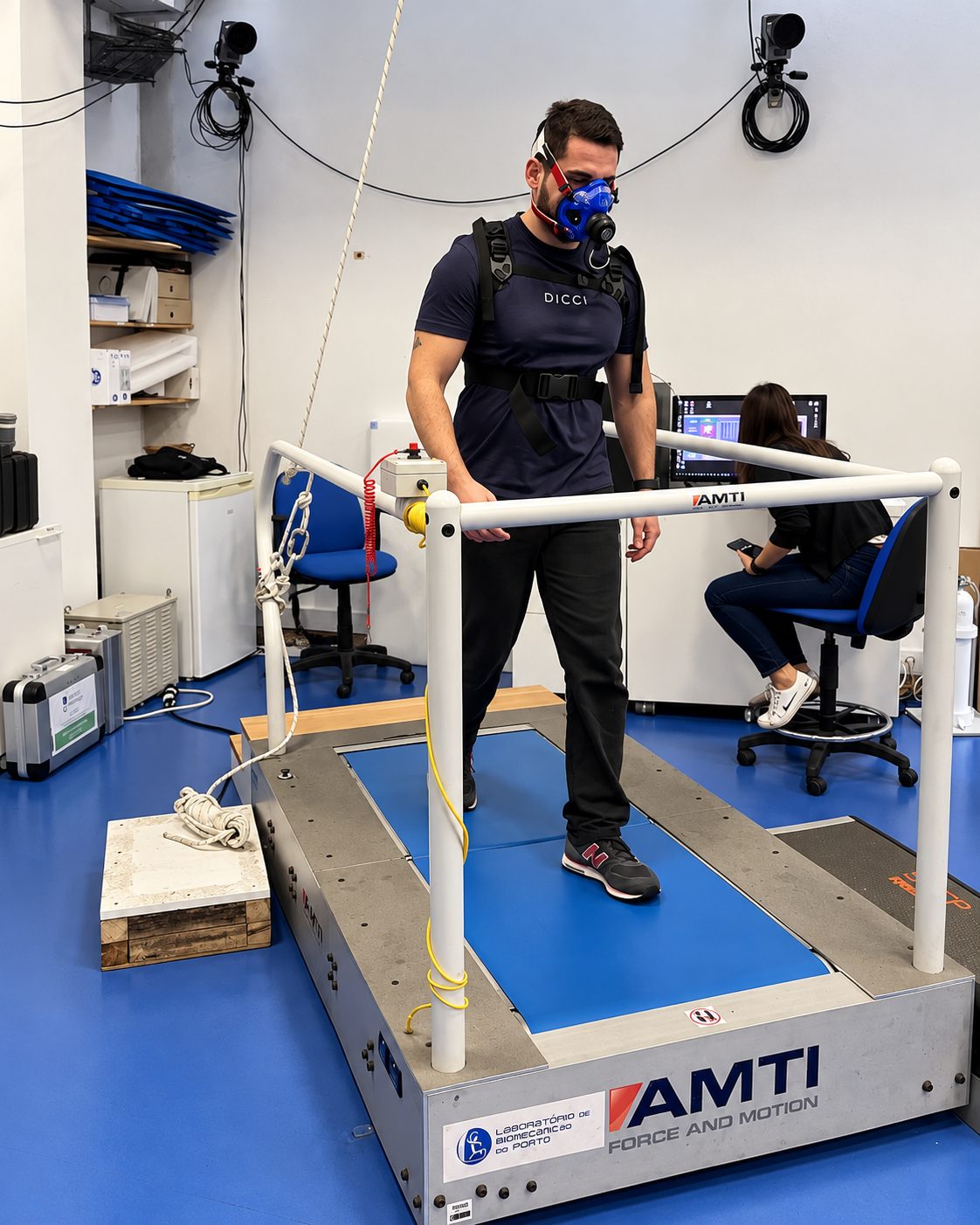
A participant walking on an instrumented treadmill while wearing respiratory measurement equipment during a KinetikOS validity study.
Validity studyKinetikOS laboratory work in a controlled treadmill setting.

What we have tested

Heel strikes and toe offs anchor the timing of a stride; stride length and speed add the spatial dimension. These studies address defined measurement questions, not product-wide clinical outcomes.

Gait: events, timing, length and speed

Step time, against force plates

ICC 0.972

Step time · phone vs force plates

Five ways to describe gait timing

ICC 0.80–0.88

Five timing measures · phone vs pressure mat

The same walk, seven days later

ICC 0.78–0.93

Healthy-adult timing repeatability over seven days

The length of each step

2.29 / 2.17 / 1.82 cm

Step-length MAE · phone / watch / combined

Timing from both phone and watch

0.83–0.84 / 0.96–0.98

Cadence ICC · phone / watch

A stride begins with two events

1.071 s / 1.072 s

Mean stride duration · optical / phone

Stride length and speed, against optical capture

0.7 cm

Mean stride-length bias

The outdoor method meets optical capture

7.6%

Stride-time limits of agreement vs optical capture

Six stride measures, repeated outdoors

ICC 0.85–0.98

Six stride measures · three outdoor walks

Five carrying positions, compared

4.4–17.5%

Limits of agreement across measures

The scale of a detectable change

1.0–3.4 cm

Stride-length minimal detectable change

Everyday movement: distance, intensity and change over time

Distance over six minutes

ICC 0.969

Six-minute treadmill distance

Walking intensity in METs

MAE 0.30 MET

Walking intensity vs metabolic system

Seven months of daily movement

7 months

Walking minutes, stride length and stance duration

Everyday gait in relation to a clinic test

r 0.69

Gait-derived score vs Timed Up and Go

Balance and tapping alongside gait

r 0.51–0.64

Derived scores vs clinical measures

Daily walking through a sudden change in routine

44% decrease

Walking minutes during COVID-19 confinement

Kinetikos Provides an Entirely New Dimension of Data

What Others Measure

Pace

  • Speed

Gait events

  • Total number of steps
  • Total gait duration
  • Total distance walked

Rhythm

  • Cadence
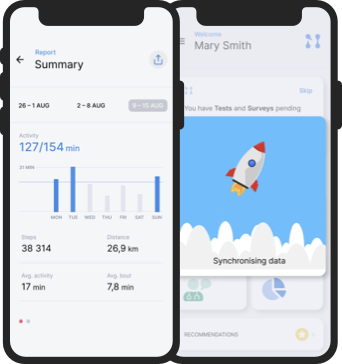
KinetikOS app screens showing mobility reports and data collection.
KinetikOS Health

What the Kinetikos Gait App Measures

Regularity

  • DFA
  • Entropy
  • Lyapunov exponent
  • Autocorrelation stability
  • Normalized peak power
  • Width peak power
  • Gait variability

Gait events

  • Total number of steps
  • Total gait duration
  • Total distance walked
  • Turning time

Rhythm

  • Cadence
  • Step time
  • Stride time
  • Stance time
  • Swing time
  • Single support time

Symmetry

  • Harmonic ratio
  • Step time asymmetry
  • Step length asymmetry
  • Stance time asymmetry
  • Swing time asymmetry

GPS

  • Momentum score
  • Oscillator score

Pace

  • Speed
  • Step length
  • Stride length

Energetics

  • Metabolic equivalent task
  • Gait intensity

Smoothness

  • Index of harmonicity
  • Jerk

Measure availability depends on collection mode, configuration and supported device. The intended set and its evidence are reviewed for each application.

Normative reference data

Compare results with the right reference population

KinetikOS includes a curated normative database, so results can be compared with age-, sex-, population- and measurement-specific benchmarks where available.

Participant contributions
82M+
Reported ages
6–106
Countries with country-specific references
48

Covers key KinetikOS measurements, including walking speed, daily steps, cadence, gait variability, physical activity and physical performance.

Peer-reviewed research

Selected published research

Published studies using Kinetikos smartphone apps and clinical inertial measurement unit (IMU) platforms, listed from newest to oldest.

  1. Combined Analysis of Gait Cycle and Imaging Parameters in Patients with Lumbar Disc Herniation: An Exploratory Study

    2026 · Annals of Biomedical Engineering · Clinical IMU platform

  2. Differential Effects of Levodopa and Stimulation on Post-Surgery Freezing of Gait in Subthalamic Nucleus Deep Brain Stimulation Parkinson’s Disease Patients: A Clinical and Kinematic Analysis

    2025 · Movement Disorders Clinical Practice · Clinical IMU platform

  3. Shoulder and Scapular Function Before and After a Scapular Therapeutic Exercise Program for Chronic Shoulder Pain and Scapular Dyskinesis: A Pre–Post Single-Group Study

    2025 · Journal of Personalized Medicine · Clinical IMU platform

  4. Scapular Motor Control and Upper Limb Movement Quality in Subjects with and without Chronic Shoulder Pain: A Cross-Sectional Study

    2024 · Applied Sciences · Clinical IMU platform

  5. 3D Kinematics Quantifies Gait Response to Levodopa earlier and to a more Comprehensive Extent than the MDS-Unified Parkinson’s Disease Rating Scale in Patients with Motor Complications

    2024 · Movement Disorders Clinical Practice · Clinical IMU platform

  6. Muscle dysfunction in axial spondylarthritis: the MyoSpA study

    2022 · Clinical and Experimental Rheumatology · Clinical IMU platform

  7. Distinct gait dimensions are modulated by physical activity in Parkinson’s disease patients

    2022 · Journal of Neural Transmission · Clinical IMU platform

  8. Smartphone-Based Body Location-Independent Functional Mobility Analysis in Patients with Parkinson’s Disease: A Step towards Precise Medicine

    2022 · Journal of Personalized Medicine · mKinetikos smartphone app

  9. The Effect of ACTN3 and VDR Polymorphisms on Skeletal Muscle Performance in Axial Spondyloarthropathies

    2021 · Frontiers in Genetics · Clinical IMU platform

  10. Unsupervised Walking Activity Assessment Reveals COVID-19 Impact on Parkinson’s Disease Patients

    2021 · Movement Disorders · Smartphone app · Research letter

  11. Feasibility of a Mobile-Based System for Unsupervised Monitoring in Parkinson’s Disease

    2021 · Sensors · mKinetikos smartphone app and dashboard

  12. Validation of quantitative gait analysis systems for Parkinson’s disease for use in supervised and unsupervised environments

    2021 · BMC Neurology · Smartphone app and clinical IMU platform

Explore the evidence for your application.

Tell us what you want to measure. We can discuss the relevant methods, study conditions and evidence with your team.

Discuss the science Explore applications

Research findings describe the studied methods and settings; they do not establish treatment outcomes.